Architectural Photography
When you search 'what is architectural photography' you get a long list of websites saying the same thing, "Architectural photography is the photographing of buildings and similar structures that are both aesthetically pleasing and accurate representations of their subjects. Architectural photographers are usually skilled in the use of specialized techniques and equipment".
(Architectural photography, 2016)
Historic England
Below is information I found when researching Historic England. It describes what it is and what they do. It is very informative information which has helped me to have a wider understanding of why documenting buildings in a specific way is important to help this organisation achieve its goal of preservation and protecting our heritage.
"Historic England’s Role
We are the public body that looks after England's historic environment.
We do this by:
- Championing historic places
- Identifying and protecting our heritage
- Supporting change
- Understanding historic places and
- Providing expertise at a local level
We champion historic places
By standing up for historic places, everyone, from individuals and communities to government and major landowners, can look after and care for heritage.
We make sure they understand and appreciate the benefits England's heritage brings and why it should be respected, cherished and enhanced as part of the very soul of our nation.
We open up heritage for everyone, using digital resources, media campaigns, our unsurpassed archive, publishing, public information and exhibitions.
We identify and protect our heritage
Protecting historic places through the designation system is at the very heart of what we do, as expert advisor to the government.
Using our knowledge and understanding we celebrate what’s special and make sure that England’s history is recognised, respected and enjoyed.
We manage the National Heritage List for England: from its origins in 1882, it has grown to include almost 400,000 items ranging from prehistoric monuments to office blocks, battlefields and parks. They all benefit from legal protection.
The list is available to everyone through our website. It continues to grow, both in size and in popularity, and now has more than a million visits annually.
We support change
We want people to use and enjoy historic places in ways that reveal and reinforce their significance, and safeguard their setting in a wider landscape.
Each year we give advice on more than 20,000 applications for planning permission or listed building consent.
We help make sure that threats to our heritage are understood, so policies, effort and investment can be targeted effectively.
We find approaches to prevent heritage at risk and tackle it as a priority. Last year, we provided £14.26 million in grants to reduce the amount of heritage at risk.
We understand historic places
We share our understanding of the significance of England’s places.
Using cutting-edge science, research,and information and by working with others, we help people manage historic places, both physically and economically.
We share our knowledge through training and guidance, conservation advice and access to resources, including the Historic England Archive, which is the biggest national collection of records about the historic environment.
We deliver national expertise at a local level
Our local offices are the principal point of contact for many customers.
Our staff specialise in assessment, processing grants, giving advice to owners, developers and local authorities, as well as designation, heritage data, government policy and communications.
Our people work with partners across each region to raise the profile of the historic environment and make sure that it makes the fullest possible contribution across the country."
Jacksdale War Memorial

(No Date) Available at: https://www.warmemorialsonline.org.uk/public/img/133853/Jacksdale.JPG (Accessed: 25 January 2017).
This is the war memorial in Jacksdale. Below is some information and the history on the monument. I found this information on the website set up for the heritage in Jacksdale and Westwood.
" The Jacksdale War Memorial is situated on Main Road, Jacksdale in the very centre of the village. It was erected in 1921 at a cost of £440, financed by public subscription. In 1959, during a storm the soldier statue on top of the pedestal fell off, smashing to pieces and due to cost and other concerns, was replaced with an ornate stone cap. The memorial remained without a soldier for fifty years but was never forgotten by the villagers and in 2009, due to local pressure and the generosity of Building Better Communities, the soldier statue was finally replaced."
The monument (2009) Available at: http://www.jacksdale.org.uk/war-memorial/the-monument (Accessed: 25 January 2017).
You can see from the above image that it is reasonably easy to access but has a shop behind it which will make photographing more difficult. It is also in the centre of a public area which means the image is likely to have people in it unless I can find a time of day when it is particularly quite and still have the right amount of lighting.
The remains of St Helen's Church South Wheatley
((I have tried to find an image to show what the site looks like but for some unknown reason it will not load onto my blogger))
I have done a little research into the ruins and found it is easily accessible. It may be best to photograph it in the week when most people are at work or in school. I think there could be an issue with people but I'll just have to check at different times of the day. It may be interesting to find out which way his building faces and look at possibly doing a sunrise or sunset shoot as well as a normal day shoot.
"Consists of a free standing arch, Norman 11th century, and the tower, Norman to Perpendicular 11th to 15th centuries. The church was declared redundant in 1883 and under a faculty from the Bishop of Lincoln the nave and chancel were demolished. The tower has an integral spiral staircase to the ringing chamber level and the remains of a frame for 3 bells dating from 1670."
(No date) Available at: https://historicengland.org.uk/services-skills/grants/visit/remains-of-church-of-st-helen-south-wheatley-dn22-9dj/ (Accessed: 26 June 2017)
Clipstone Headstocks
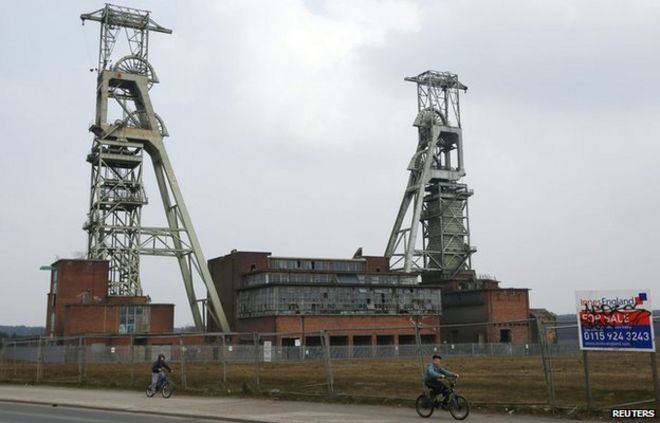
(Article dated: 9 March 2015) Available: https://ichef.bbci.co.uk/news/660/media/images/81441000/jpg/_81441145_81366441.jpg (Accessed: 26 June 2017)
The headstocks are very easily visable with nothing in the background. On the downside though, they are surrounded by barriers and fencing which could cause an issue with taking the image. It is not a pretty sight to see in a professional image so I will have to go and check the area out first to see if there are any ways around this.
Bestwood Winding Engine and Headstocks

(No date) Available: https://media-cdn.tripadvisor.com/media/photo-s/03/ac/0b/5e/bestwood-winding-engine.jpg (Accessed: 27 June 2017)
This site is easily accessible. I will need to visit first to check for any railings and view the site so I can do my risk assessments. I can see from the above image that there is woodland behind which on a sunny day would look impressive and make the building jump out at you.
The Old White Hart - Market Place Newark

(2002) Available: http://www.nottshistory.org.uk/images/newark/white-hart-2002.jpg (Accessed: 27 June 2017)
This is based in a very popular and busy town centre. Newark is normally full of people at a weekend and on market days. I think it would be nice to get a couple of shots with people in, but also ones without, so the building can be appreciated without the viewers attention being taken away to look at the surrounding people. I will need to look into which days are the quietest and also make sure it is a bright day to shoot as I know it is a built up area so potentially quite dark.
((Again with this image and the image of The Governors House I cannot get these to load properly. I will use my on imagery to show what they look like when I visit to view the areas and do my risk assessments))
The Governors House, Stodman Street, Newark

Rufford Abbey Country House Remains

(No date) Available: http://www.newarkcivictrust.org.uk/public/images/image5.jpg (Accessed: 27 June 2017)
Again, this is based in the busy town centre of Newark. Weekends and market days are the busiest times so it would be a good idea to try visiting the site on a quiet day or at a quiet time of the day without the lighting being too poor.
Rufford Abbey Country House Remains

(No Date) Available: http://www.parkwoodleisure.co.uk/Content/images/rufford-hero.jpg (Accessed: 27 June 2017)
I think this site is going to the most difficult to photograph, especially with it being Summer and it being a very popular place for local people and tourists to visit. There are often weddings here which can also make my shooting difficult. I think I will visit this site in an evening to start with as it gets to dusk so I can take my time to view and risk assess. I have been told I can advise park wardens of my being there and ask for assistance from them. They may be able to help me pick the best day and time to do the shoot (weather depending). I have photographed this building before as a personal project but not as a professional shoot so it will be interesting to see how the images differ.
When visiting these places I will be doing risk assessments to make sure I and my assistant are going to be safe from trips, falls and traffic. I will be creating another blog post containing the risk assessments and practice shots.


